The scholarly journal “Aktualu rytoj / Relevant Tomorrow” invites submissions for a special issue “Education After Totalitarianism: Legacy and Transformations in Central and Eastern Europe”
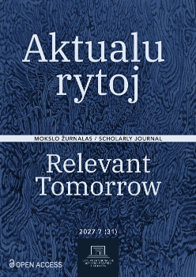
Volume 7, Issue 31 (2027)
Deadline for full paper submissions: 12 February 2027
The years 1989–1991 marked a historic turning point when the nations of Central and Eastern Europe freed themselves from Soviet and socialist systems and entered a new phase of democratic statehood, cultural development, and societal transformation. Education became one of the key arenas of this transition. Across the region, education systems underwent profound changes in values, institutional structures, and curricular content, moving away from ideologically driven models toward more open systems fostering critical thinking, civic responsibility, and European integration.
The issue focuses on the transformation of education systems in Lithuania and other Central and Eastern European countries after 1989–1991, from early reforms to present-day challenges. More than three decades later, these processes reveal both shared regional patterns and significant differences. Most countries have undergone similar developments, including cycles of decentralization and recentralization, implementation of the Bologna Process, and ongoing digitalization with the growing influence of artificial intelligence. These changes have been accompanied by a stronger emphasis on inclusive education, rising concerns about data protection and cybersecurity, and simultaneous trends toward greater inclusion and increasing polarization.
Compared to neighbouring countries, Lithuania’s trajectory reflects both shared regional trends and distinct national developments. The reform of the Soviet education system began with the introduction of the concept of a national school, which since the early 1990s has evolved into a model increasingly integrated into the European educational space and oriented toward the promotion of liberal democratic values. Since 1990, non-state schools have also emerged alongside state institutions, established not only by commercial actors but also by local communities. Through the adoption of globally recognized educational paradigms—such as Catholic and other Christian approaches, Montessori, Waldorf, Summerhill, humanistic, open-air, and Suzuki methods—as well as the development of locally distinctive models, educational diversity has significantly expanded. However, key challenges remain, including regional disparities, inequality among schools as communities and institutions, the declining prestige of the teaching profession, bureaucratisation, and uneven reform implementation, as well as a mismatch of existing school buildings with the spatial needs of up-to-date educational methods.
We welcome original papers on the following topics:
1) reforms in educational policy and evolving governance models;
2) value-based, cultural, economic, and civic foundations of education in post-totalitarian contexts;
3) changing roles and functions of schools, universities, and other educational institutions;
4) transformations in the roles of learners (pupils, students) and educators;
5) the impact of European integration, international cooperation, and the Bologna Process
6) digitalisation and technological change in education systems, including challenges posed by artificial intelligence;
7) issues of inclusion, equity, and regional disparities in education;
8) long-term implications of educational transformation for society, state development, and regional cohesion.
The special issue is scheduled for publication in Aktualu rytoj / Relevant Tomorrow, Volume 7, Issue 31 (2027). Its Scientific Editor is Dr Darius Žiemelis ORCID.
We look forward to your contribution to this special issue and to advancing our understanding of how education across Central and Eastern Europe has been reshaped since 1989–1991. We welcome diverse perspectives that connect the historical legacies of educational reform with the challenges facing education today.
Manuscripts may be submitted in English or Lithuanian and should be prepared in accordance with the journal’s submission guidelines. Please consult the guidelines and submit your full paper through the journal’s online submission system by 12 February 2027.
For inquiries about the special issue, please contact us at Relevant.Tomorrow@lnb.lt. We will respond as soon as possible.





 Open Access